History of Great Northern 1146

For starters, allow me to present a history page I wrote for the Minnesota Transportation Museum's web site: Click Here.

Pre-History

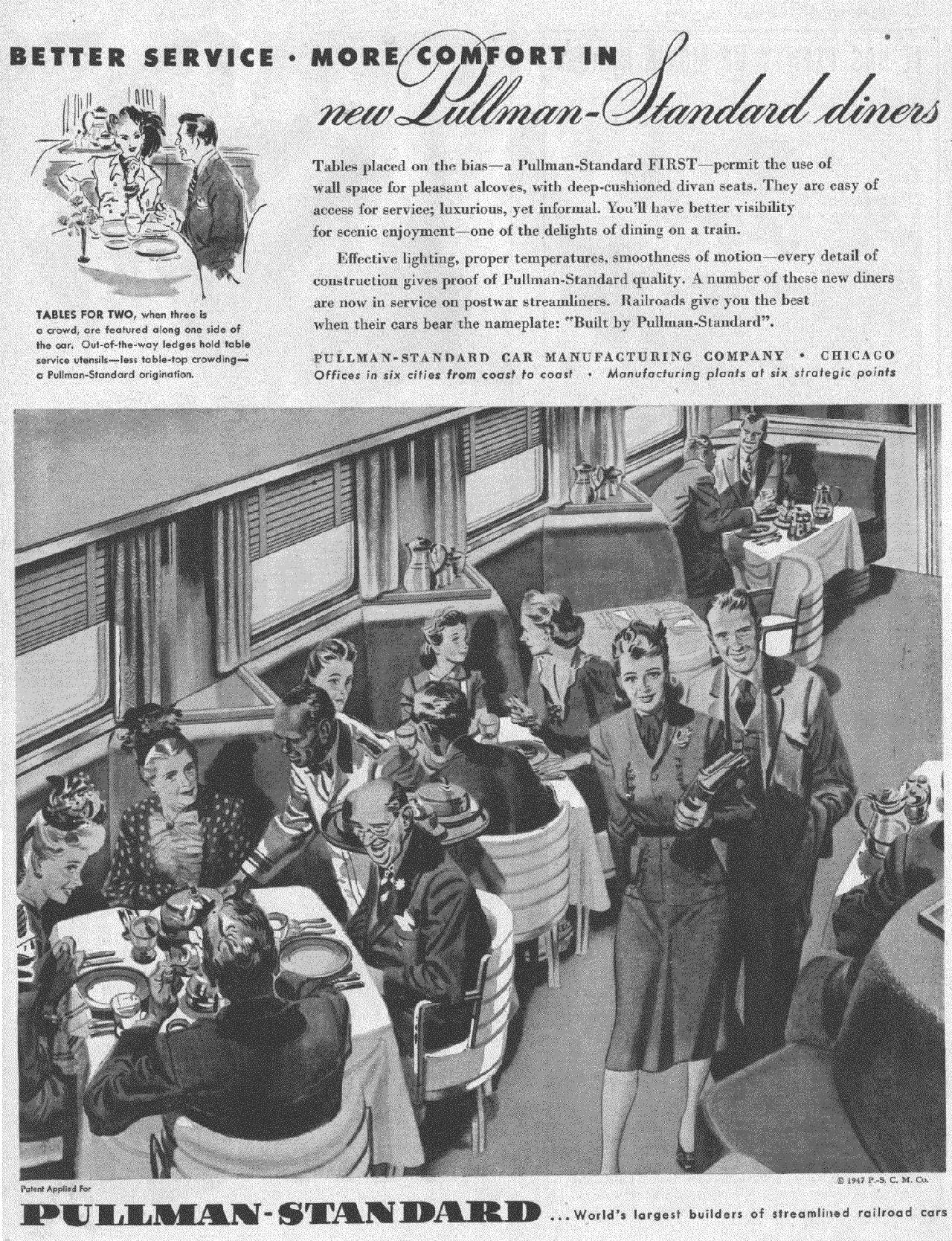
The arrangement of 1146's dining room, while unusual, is not unique to ACF or the Great Northern. Here is a 1947 Pullman advertisement which is almost prophetic.

Pullman Dining Car Ad

Why 1146 is 1146 (and has No Name)

The Great Northern seems to have put each major passenger car purchase in the next hundred. In 1947, when the new Streamlined Empire Builder equipment arrived, the highest-numbered cars were the 1000's. The new Empire Builder cars therefore became the 1100's. Front-to-rear, each type of car was assigned to its own number block:

E7500-509
RPO-Baggage1100-1104
60-seat short-distance coach1110-1114
48-seat long-distance coach1120-1134
Coffee Shop-Dormitory1140-1144"____ Lake"
Diner1150-1154"Lake ____"
4-8-4 Sleeper1160-1169"____ Pass"
16-4 Sleeper1170-1184"____ Glacier"
Sleeper-Obs1190-1194"____ River"

The new "International" equipment was ordered just after the war, but not delivered until 1950, so it was numbered in the 1100's with the 1947 Empire Builder. One oddity is that the diners were grouped in the 1140's with the Coffee Shop cars, rather than in the 1150's with the dining cars.

E7510-511
RPO-Baggage1105-1106
60-seat short-distance coach1115-1118
Coach-Diner1145-1146
Buffet-Lounge-Obs1195-1196"Port of ____"

Likewise with the new "Red River" equipment. Note the 60-seat coaches landed in the 48-seat coach number range where there were enough numbers available. Also the observation car fell in the 1140's with the Coffee Shop-Dormitories and the Coach-Diners, rather than in the 1190's with the other observation cars.

E7512
RPO-Baggage1107
60-seat short-distance coach1135-1137
Diner-Coffee Shop-Lounge-Obs1147"Red River"

The railroad had ordered just enough streamlined cars for the five Empire Builder sets. Passengers weren't very tolerant of heavyweight cars being substituted when the streamlined cars were in the shops, so soon additional protection cars were procured. In the 1140's, an additional Coffee Shop-Dormitory, the 1148 "Devils Lake" was home-built by GN's St Cloud Shops.

Thus the Coach-Diners share a very crowded number range:

Why weren't the Coach-Diners named? They directly contradict the GN's practice of naming anything with sleeping, food service, or first class facilities. If I ever learn why they're nameless, I'll post the reason here.

In the meantime, its fun to speculate what they might have been named. Food service cars tended to be named after bodies of water along their intended route. Of the International's obs cars, 1195 got a south-end name and 1196 got a north-end name. So my hypothesis is that 1146 would have been named for something wet around Vancouver. Following the tracks up from the international border, some possible names include:

I think my own guess would be 1145 "Elliott Bay" and 1146 "English Bay".

Construction

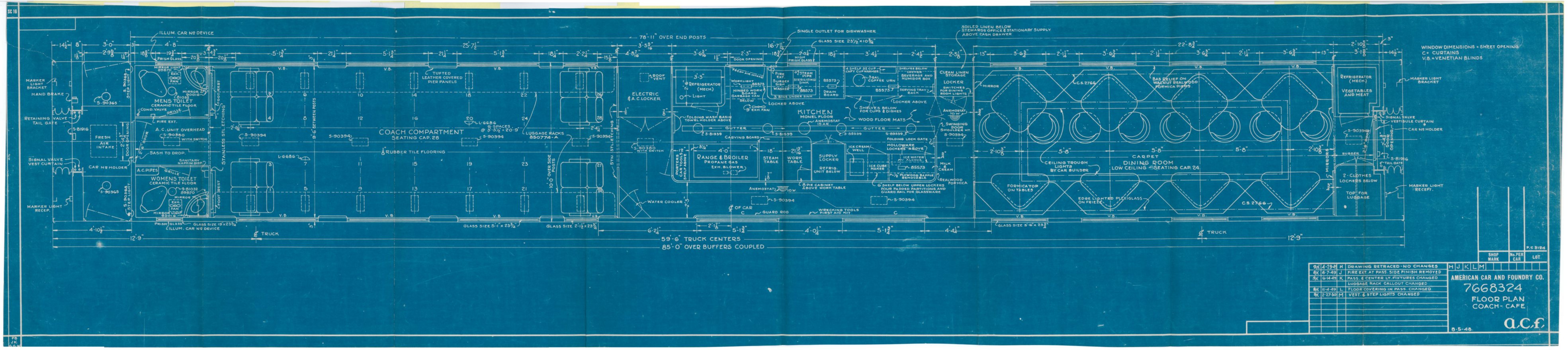
According to the dates on the blueprints, engineering for the five types of cars in the "International" took about 13 months - from September 1948 to October 1949.

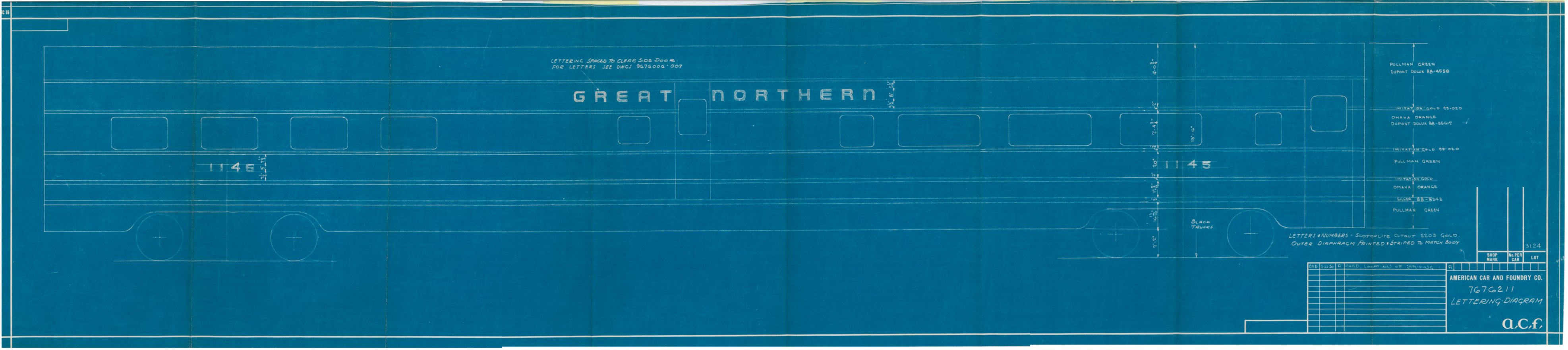
ACF probably painted the "International" and "Red River" cars according to this Pullman painting diagram.

The International

The GNRHS has published two reference sheets covering the 1950 "International". First is 289 "Seattle-Vancouver (BC) Passenger Train Service 1891-2000" by John F. Strauss, Jr. It offers an excellent "Big Picture" overview of the Seattle-Vancouver corridor, which despite recent interruptions, still operates today. Second is 313 "Great Northern's Internationals - 'A Snappy Diesel-Powered Train' for the Pacific Northwest" by James H. Larson. This focuses on the complete post-war re-equipping with 100% new equipment. It contains a fascinating discussion of differing accounting methods, one which identified the full dining car service as the biggest looser - leading to the removal of 1145 and 1146 from the trains - and one which identified food service as a key draw for lucrative Southern California through passengers.

After the inauguration of the entirely-new, all-streamlined "International", ACF published this newspaper's review in its employee magazine.

Front Cover Thumb Page 13 Thumb Page 14 Thumb Page 15 Thumb Page 16 Thumb Page 17 Thumb Back Cover Thumb
Front Cover Page 13 Page 14 Page 15 Page 16 Page 17 Back Cover

Adlake put a two-page add in the July 1st issue of Railway Age, to sell its aluminum sash window units and interior hardware.

Page 8 Thumb Page 9 Thumb
Page 8 Page 9

O. M. Edwards Co. contributed the roll-up vestibule steps, and was proud to say so in Railway Age. While the left photo is not of a GN car, that's "International" tail car 1196 "Port of Vancouver" on the right.

Edwards Sash Ad

James L. Howard & Co. contributed hardware, purchasing a quarter-page Ad from Railway Age.

Howard Ad

Heywood-Wakefield followed a two-page add in the October 28th issue of Railway Age, touting its seating products used in the GN's "Red River" and "International" trains. Left to right, the interior views are: Red River coach, Red River coach, International observation car lounge, International Coach-Diner

Page 68 Thumb Page 69 Thumb
Page 68 Page 69

The Great Northern published an advertising folder in August 1951, praising the virtues of its 'Internationals'. It includes the first color images of the interior I've found, so I got quite excited. These scans appear courtesy of Lindsay Korst and his web site, www.gngoat.org. Click here for the whole brochure.

Observation Lounge Cafe Coach Coach Coach Women's Coach Men's
Observation Lounge Cafe Coach Coach Women's Men's

These scans are from a Great Northern passenger car equipment book I found at Como Shops (book store) several years ago. (Obs car scan from Ben Ringnalda.) They show the ten passenger cars constructed by ACF in 1950 for the Great Northern's Seattle-Vancouver "International". The equipment, along with two E7 locomotives from EMD, formed two train sets which covered three trains each way per day. I've laid the plans out in the same order as the train. There were two coaches per train, so the scan appears twice.

RPO Baggage Car Diagram 60-Seat Coach Diagram 60-Seat Coach Diagram Coach Diner Diagram Observation Lounge Diagram
1105 1115 1116 1145 1195 "Port of Seattle"
1106 1117 1118 1146 1196 "Port of Vancouver"

Of the 1950 "International" rolling stock, five of ten cars are known to survive:

Lines East Pool

After being removed from the "International", 1145 and 1146 moved to St Paul, Minnesota. Through the 1960's they served on local trains terminating in St Paul.

"Great Northern Pictorial - Volume 5", by John F. Strauss, Jr. shows a train departing the St Paul Union Depot on page 73. The second car is either 1145 or 1146. Caption: "'The Stub', train #3, which replaced the 'Western Star' on May 22, 1960, between St. Paul and Minot via the Elk River-St. Cloud Line, Grand Forks, and Devils Lake, departed St. Paul Union Depot ." Another picture of "The Stub" appears on page 76 - with 1145 or 1146 as the third car.

1145 appears on page 97 of the same book. The accompanying text says the pair were assigned to the St. Paul-Fargo "Red River" following May 27, 1962 schedule changes. The westbound route was over the Elk River line, while the eastbound was over the Willmar line. Westbound the coach-diner ran dinette forward behind the head-end cars. The train was not turned, so eastbound the dinette end carried the markers at the rear of the train. Both directions are pictured, the westbound on 97 and the eastbound on 99.

A favorite picture of mine appears on page 115. It shows a passenger F, a baggage car, 1146 dining room forward, and two ex-C&NW 400 coaches on the Dakotan in August 1965. It tickles me because the Minnesota Transportation Museum has enough ex-GN equipment to re-create the train. (It would include F7 454-A, baggage car 265, coach-diner 1146, and 400 coaches 1097 and 1096.) In fact, in the picture MTM's 1096 is carrying the markers. I've had the pleasure of putting about five winters into restoring that car. Other Dakotan pictures featuring coach-diners appear on pages 117, 130, and 131; and text describing the St. Paul-Minot Dakotan appears on page 120.

Page 154 has three Dakotan pictures featuring the coach-diner twins. Two were taken in 1968, after my debut in this world, and one in 1969. The 1969 photo is a real teaser because the coach-diner is painted in Big Sky Blue, but the car's number isn't legible. The consist is unchanged.

In the November, 1980 issue of Model Railroader magazine, author Mike Schafer wrote an article on "Pike-size passenger trains." His third example was the Great Northern's four car 1969 Dakotan, complete with 1145/1146 on the rear and instructions of how to kitbash them. Recently, this article has been available for download.

Burlington Northern 21 & 22

GNRHS reference sheet 307 "Portland Passenger Train Service 1879-1971" by John F. Strauss, Jr. lists 1145 in the July 2nd 1970 consist of BN train 21 (Spokane to Portland leg of the Empire Builder and North Coast Limited). The accompanying note says "GN 1145, which had replaced a dining car, provided Continental breakfast service into Portland Union Station. This car and GN 1146 had been reassigned to BN Nos. 21 and 22's consists from discontinued Lines East passenger trains in order to reduce food service expenses."

This came from a photocopy of four black & white prints Bob Moen found. The original photographer is unknown. It was taken in the BN's ex-NP coach yard down by Dayton's Bluff in St. Paul in the late summer of 1970. Notice the two cabinets for 100-lb propane bottles are still there, as are the weather-cock type kitchen vents. These were removed by Amtrak within a few years of this photo.
At NP coach yard

Amtrak

These are from an Amtrak equipment diagram book from Bob Moen's collection. I know it is dated 1977 or slightly later, because the first Amfleet cars appear, but very few heritage cars have been removed.
Amtrak Diagram Amtrak Diagram

Winona Minnesota John Goodman found this slide in an estate sale. (Sorry, don't remember the photographer's name.) Written on the slide: "Amtrak 8400 Cafe-Lounge Winona 7-30-73". This is 1146's twin, 1145, resplendent in new Amtrak paint.
LaCrosse Wisconsin This comes from the same estate sale. Written on the slide: "Amtrak - Milw 3270 - Port of Seattle (obs) Lacrosse 1-19-74". Notice 'Port of Seattle' is coupled to either 8400 or 8401. It sure looks like 8401 to me - 1146. Notice the weather cock on the roof: It hasn't been rebuilt yet. These two ran coupled together like this on the 'International' - and here we have an encore at age 24 on Amtrak. Some others and I tried to acquire the 'Port of Seattle' and donate it to MTM, but the arsonists beat us to it.
Williston North Dakota Bob Moen took this photo of 1146, now Amtrak 8401, in Willison, North Dakota in 1975. Williston is still served by Amtrak's "Empire Builder". Notice the adjacent car is still in GN Big Sky Blue. 1146 is in Amtrak's original Platinum-Mist and red/white/blue "Pointless Arrow" paint job. At the time we thought it looked awful. Now seeing it makes me feel sorta nostalgic. Notice also, directly above "8401" on the side, the weathercock-type exhaust hood has been replaced by a fixed cap.
St Paul Minnesota This comes from the same estate sale. Written on the slide: "Amtrak - Diner 8401 St Paul 5-20-78 W.B. E. Bldr.". She is probably within a year of retirement, she's almost got more dirt than paint, and the rebuild has occured. (Bonnet exhaust cap replaced the weather cock, propane tanks removed.)

Editorial comment on the last picture above, of 8401 on the Builder in St Paul in 1978. She may look old and weary, but folks that's neglect not age. She was between 28 and 30 years old when she was retired - the same age as most of Amtrak's current fleet is today! Amtrak in the 70's was chronically under-funded, and the equipment suffered horribly.

I scanned this from page 91 of Patrick Dorin's book "Amtrak Trains & Travel" (Superior Publishing Company, 1979.) I'm particularly fond of it, because it shows Amtrak's in-service decor. As you'll see in the restoration photos, the Amtrak route map on the wall was gone by the time I first set foot in it. Judging by other Amtrak signage, and the adhesive left on the wall, it was probably printed on adhesive-backed, brushed aluminum foil.
Amtrak Interior Decor

Museums and Private Ownership

It appears that 8401 was sold at Amtrak Auction, circa 1979 to 1981, to a Mr. Al Knippert. How it spent its time in his ownership is unknown to me. He may have eventually donated it to a museum in New Orleans.

A fellow RPCA member and car owner bought two cars from the Louisiana Railway Heritage Trust in 1994. He reports that 8401 was at their location in New Orleans at the time, inside a fenced area. It had already been sandblasted and painted in yellow primer.

Bob Moen purchased 8401 in 1998, and changed its car number back to 1146. He moved it to Hooper, Nebraska and had wheel and window work done. (I understand it traded for two better wheelsets from CNWX 301036, a CNW '400' coach turned MOW car.) Later he moved it to Randolph, Minnesota.

I purchased 1146 from Bob in February 2001.

The GN "International" Route Today

Passenger trains still ply the GN's "International" route. Today it is the Amtrak Cascades route, a service supported by Washington State and using Italian "Talgo" passenger cars and EMD F59PHI locomotives. The new trains are pretty neat, incorporating coach, business class, a bistro and a cafe. With a locomotive at each end, there's no observation car, but the side windows are still large to accomodate the wonderful scenery.