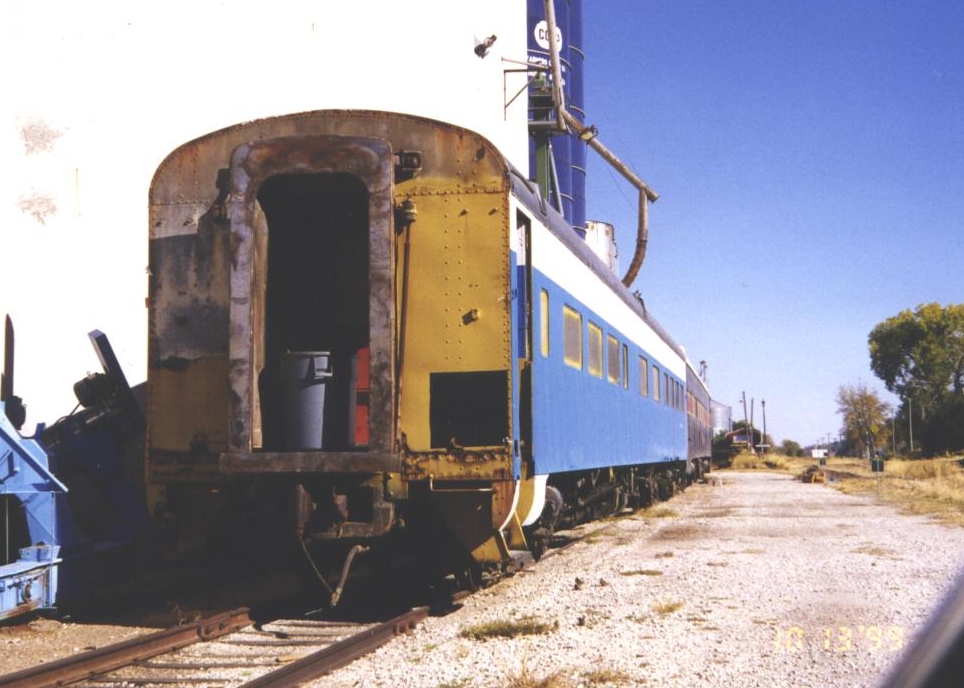
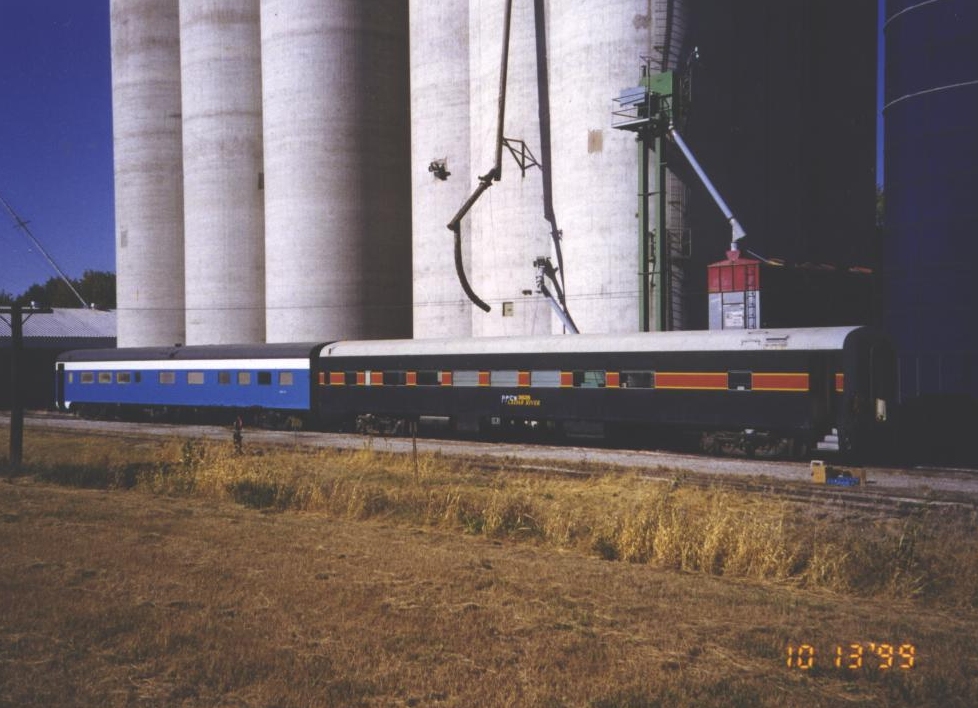
These two photographs were my first introduction to the car I would one day own. From the "small world" department: My dad was working for an engineering firm in Omaha. He'd been at a client west of Omaha, taking pictures with the company 4x5 camera. By chance he drove through Hooper, Nebraska and saw some passenger cars. Thinking I'd enjoy them, he took a few pictures.
What neither of us knew is that two of these cars belonged to a friend of mine, Bob Moen. 1146 is on the left. The other is an IC coach. Bob had found 1146 languishing in New Orleans, and bought it to save it from destruction. It must have looked hideous, as it had been sandblasted and painted in yellow primer some time ago, and then left to the elements.
In the pictures, Bob was nearly finished painting the exterior. Notice the near end is still yellow primer. He likes both of the Great Northern's passenger color schemes, so he painted the left side in their post-WWII "Empire Builder" Omaha Orange and Pullman Green, and the right side in their 1967 "Big Sky Blue".
Around this time, Bob noticed the window gaskets were old, dry and cracking, and causing water damage inside below the windows. He broke the window frames loose (very rusty screws) and put in new gaskets.
The other job Bob did in Hooper was replacing the fairly thin B-end wheel sets with a less-worn pair. The donor car was an ex-C&NW coach turned UP MoW car. That is why the 2nd axle no longer has the Spicer drive box.
I'd better explain some technical jargon. If a passenger car has only one hand brake, the car end where it's located is the "B" end. Like most streamlined passenger cars, 1146 has one handbrake, located in the vestibule right next to the steps. The opposite end of the car is the "A" end. When looking at the B end of the car, the left side is on the left and the right on the right. So, in the end view above, the B right ("BR") corner of the car is closest to the camera, and the diagonally-opposite A left ("AL") corner is the only one not visible at all. Things like axles are numbered from the B end.
1146 had a 20 kilowatt, 32-volt DC generator for lighting and air conditioning, which was connected to the second axle. There was a differential-like gear box clamped onto the axle - sold by Spicer - which powered the generator through a drive shaft and clutch.
I, meanwhile, was knee-deep in an SAP R/3 implementation for a small medial diagnostics company owned by American Standard. Does anyone remember Y2K? Companies were willing to spend a lot on new computer systems to avoid its potential problems.