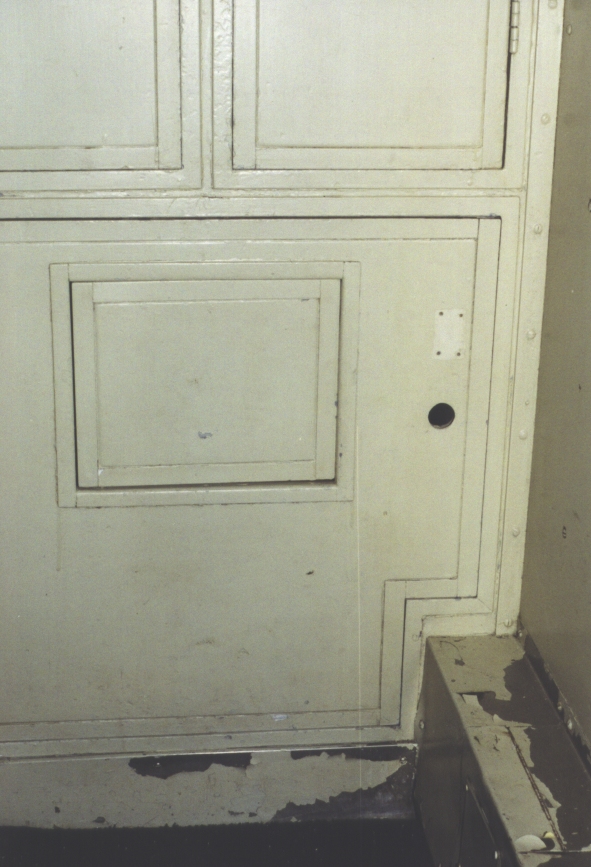
To make it easier to shop for parts, I started taking pictures of what I needed - either a sample, if I could find one somewhere, or the location on the car where the missing part should be. These pictures proved to be a real help, because passenger car hardware is just so many variations on a theme. In a cramped storage car, one hinge out of hundreds may look pretty close, but when it comes to installation it turns out to be for a thinner door, a different trim style, taller than the original, etc.
Here are a few of the parts shopping pictures. They provide some interesting detail we might not otherwise notice.
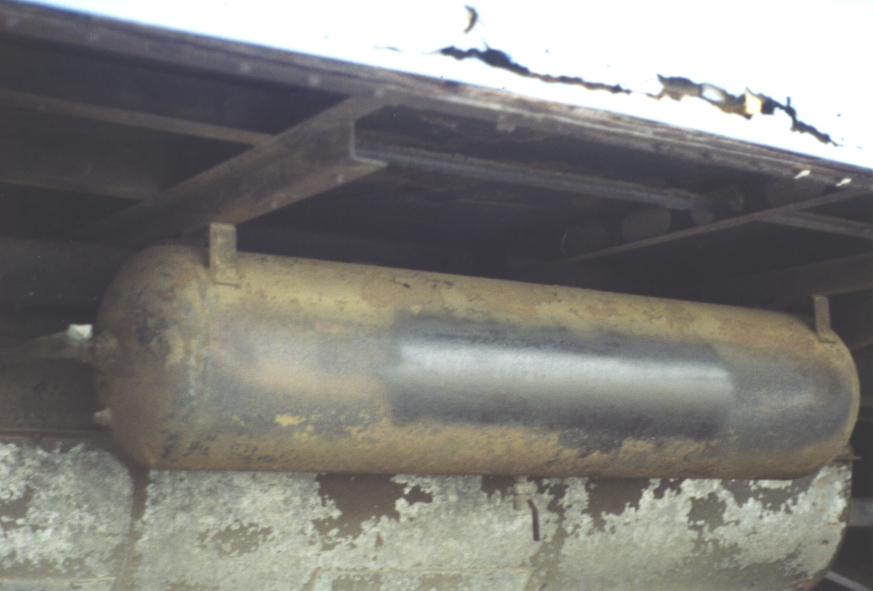
| This is the air brake supply reservoir. A D-22 system should have two, and it's easy to see the torched-off bolts and plugged air pipe that mark where the second was. Techno-tidbit: Earlier brake systems used a 2.5:1 ratio between the reservoir volume and the brake cyliner volume. This simple arrangement allowed a 20 psi service reduction to cause a 50 psi brake cylinder pressure. D-22 was engineered for flexibility in number, size, and location of brake cylinders. This was done by attaching fixed 2.5:1 volumes to the control valve, to establish the correct brake cylinder pressure, and then using these near-infinite supply reservoirs and a relay valve to deliver the correct volume of air to the brake cylinders. |
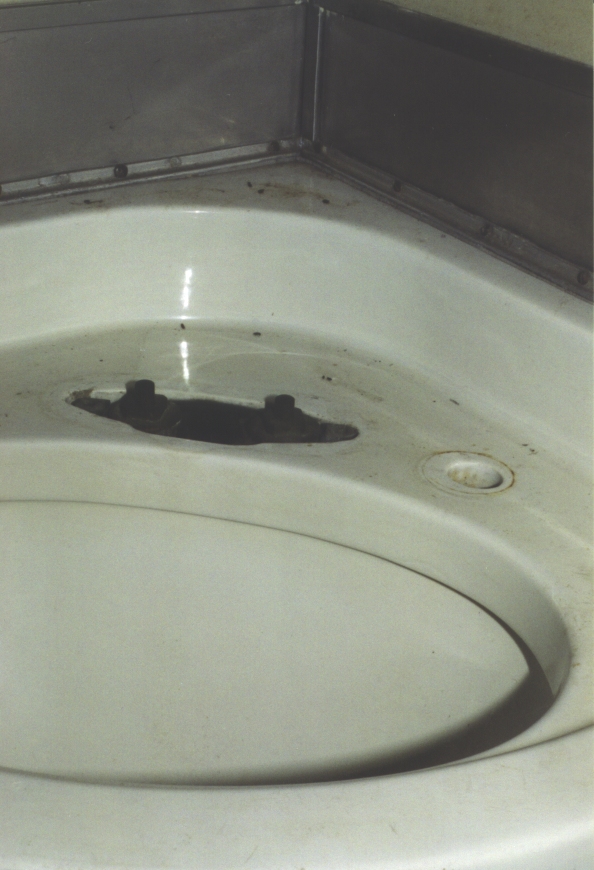
| Here's one of the restroom lavatories. Someone removed the chromed top part of the faucet, but left the valve body underneath. The hole on the right was the liquid soap dispenser. |
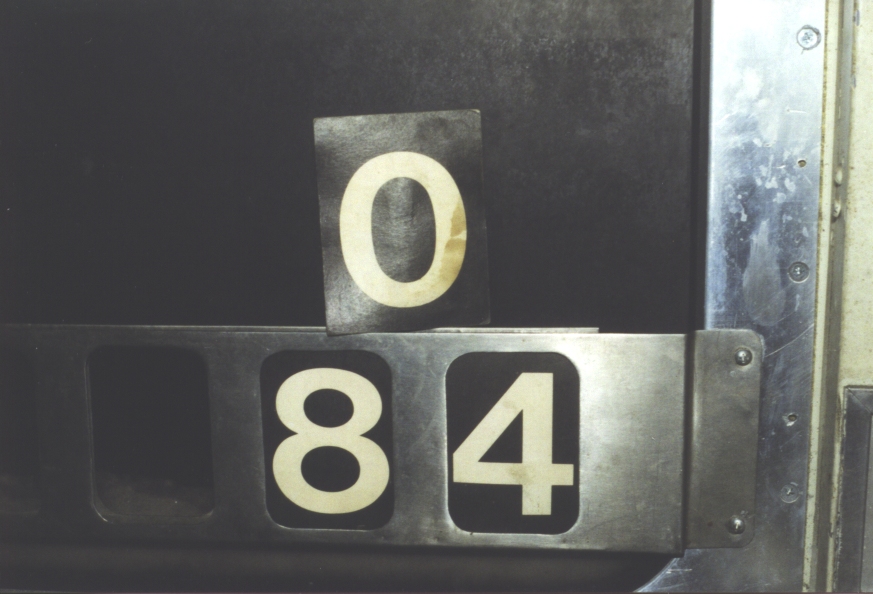
| Something oddly missing in many museum cars is the car line number box. These allowed the ticket agents to sell reserved seats as "line 110, seat 17". On the actual train, "line 110" might be coach 1213, 1096, 1320, or whatever else happend to be available in the coach yard. 1146's originals were illuminated. Today it has simple stainless holders for printed cardboard numbers. |
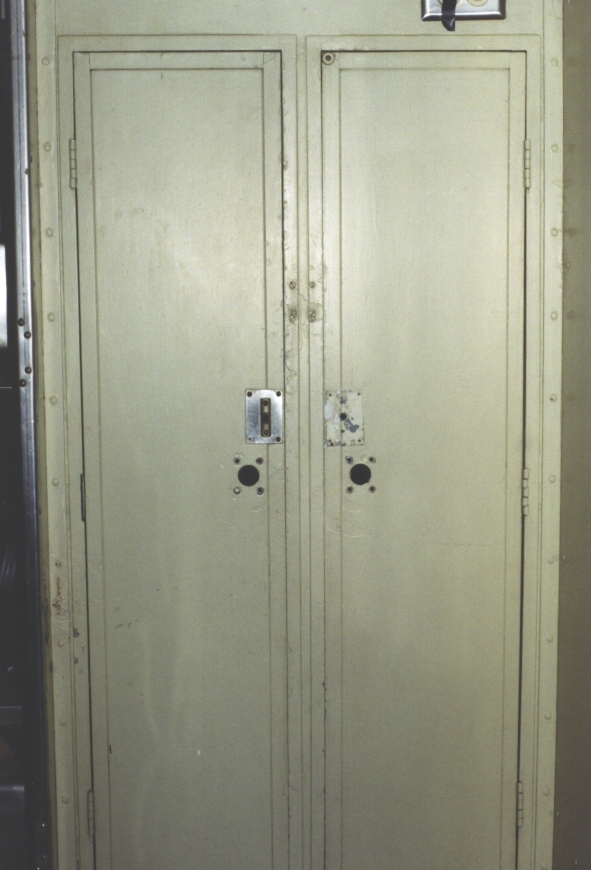
| Just because this hasn't been seen yet - the linen locker between the kitchen and the dining room. Fresh linens were on the left. On the right were supplies of GN stationary for guest's use and the cash drawer (with US and Canadian currency.) The double light switch above controls the dining room lights. |
| Below the fresh linen cabinet is a hamper for soiled linens. |
I went to a wedding at the Stuhr Museum of the Prairie, in Grand Island, Nebraska. That's real close to Dave Varilek in Freemont, so I emptied my pickup truck for the trip. The wedding was Saturday, and I went parts shopping at Dave's on Sunday. Dave had responded to my "parts wanted" plea on railswap.org six months earlier, but I had dropped the ball. Now, since I was going to be in the area, I wanted to meet up with him.
I had a stack of photographs, with notes on the back. We sorted through the photos, sorted through his stuff, and tried to find good matches. Some were pretty difficult - there might be sixteen different variations on the same hinge, or coat hook, or door latch. If I recall, we were able to find:
Let me talk a bit more about that electrical panel. To upgrade a passenger car to use Amtrak head-end power (HEP), all a person really needs is to find a copy of the specification for private cars which Amtrak put together in the 80's, an electrical parts supplier, and a good enough working knowledge of things electrical to avoid killing anyone.
For those who don't want to reinvent the wheel, Northwest Rail Electric designs complete HEP and heating, ventilating, & air conditioning (HVAC) systems for upgrading railcars. Some of the components they fabricate, others they resell.
Well aware of their products, I was intrigued when Dave brought out a long wooden crate on a forklift. We unscrewed the lid, and inside was a brand-new, never taken out of the box Northwest Rail Electric control panel. It was a high-end model, able to power the car from HEP trainline, yard shore power, or an on-board generator. It could also power the HEP trainline from the on-board generator, and could automatically start the generator and fail over when HEP train line power is shut off. Other features included one stage of air conditioning and three stages of heating. Dave explained that it had been built in 1996 for Southern Pacific business car 100, the "Airesley", but never installed because the car was retired after the merger with the Union Pacific. And the price was extremely reasonable.
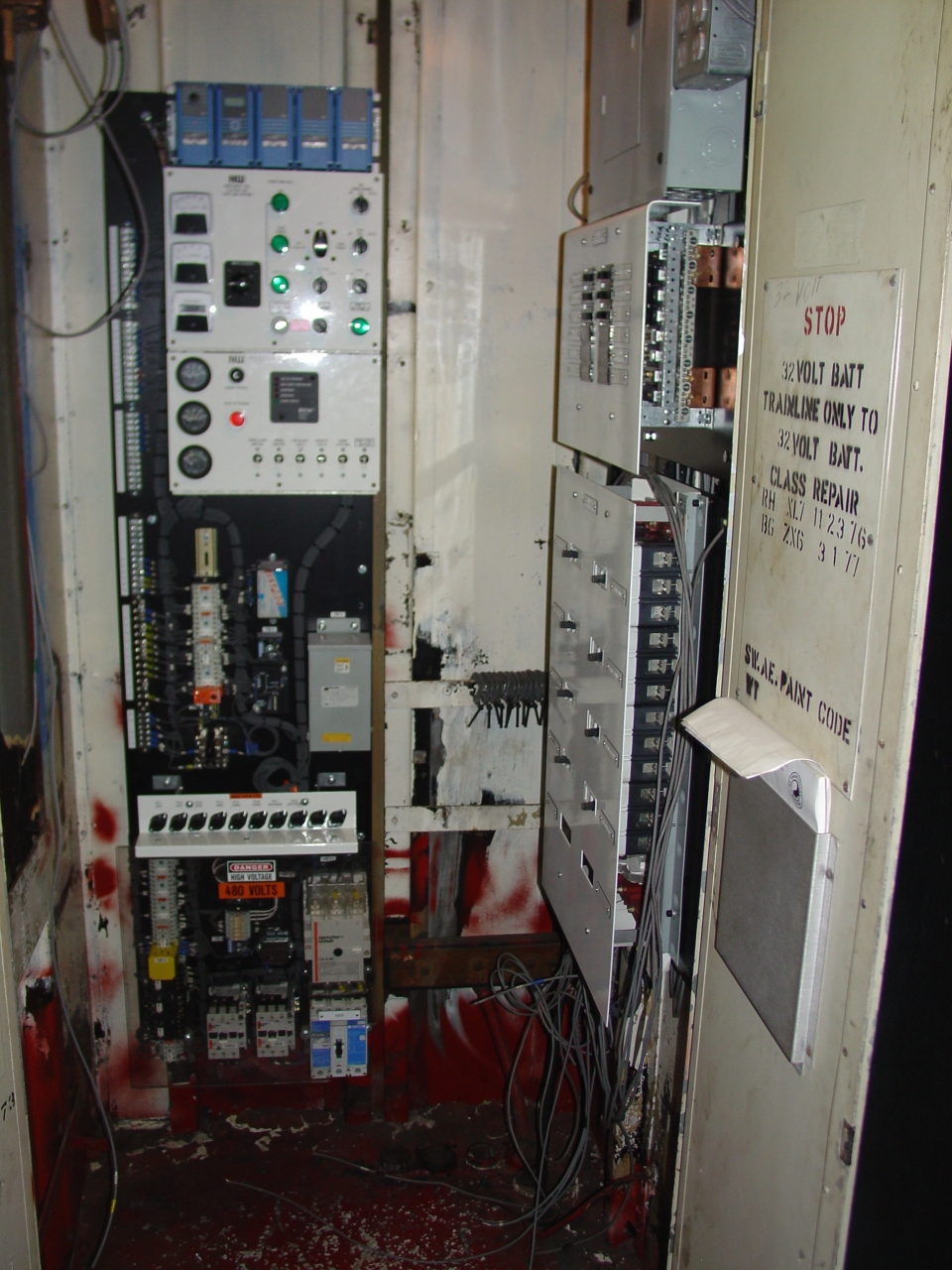 | This was a big deal. The new electrical panel has been mounted in 1146's electrical cabinet. The 208Y/120 lighting panel is in the middle on the right, below my first one. The 480 delta panel is below it. The logic panel is on the back wall. The left wall I've reserved for a 32vdc feed to the museum's "Legacy" 32vdc cars. These panels are heavey, and the logic panel is on a 3/16" panel which is very flexible. A friend, Jeff Power, had to hold them steady while I clamped on a dozen of those little 1" C-clamps. Then he had to do it again while I made adjustments. Later I came through with a drill and tap to properly fasten them. |
My friend, Ben Ringnalda, discovered the John W Barringer III library in St. Louis has the ACF builder's photos and bills of materials ("BOM".) I'm especially intrigued by the BOM, because that will provide makes and models for the interior finish items I'm searching for. I inquire, and discover a $35 membership fee will more than pay for itself in member discounts. They advise that the BOM for lot 3124 is 281 pages, which works out to $137.80 for a member or $175.90 for a non-member. They also have 36 black & white builder's photos. Photocopies are $.15 ($.30 non-member) and prints are $35.00 ($50 non-member.)